

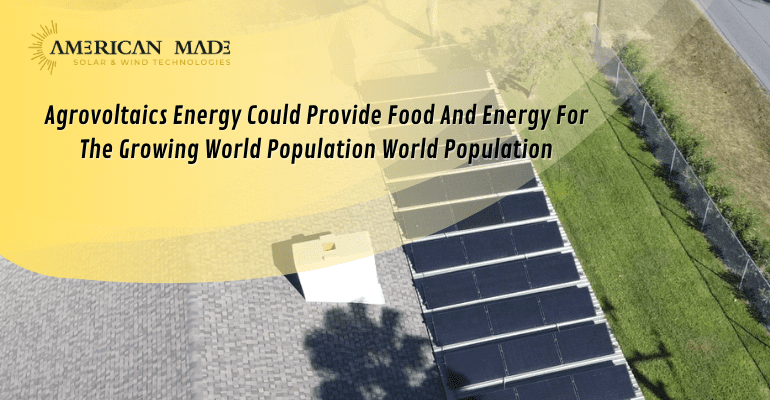
Sustainability is now sought in the agricultural sector, it is called agrovoltaics energy, it would be the production of solar energy and agricultural activity (such as cultivation or pasture) on the same land.
Although this method is not new, it is starting to be developed worldwide: in the USA there are more and more agrovoltaic projects, and in countries such as Germany, France or Italy they are already working on a specific regulation.
What is agrovoltaics energy and how does it work?
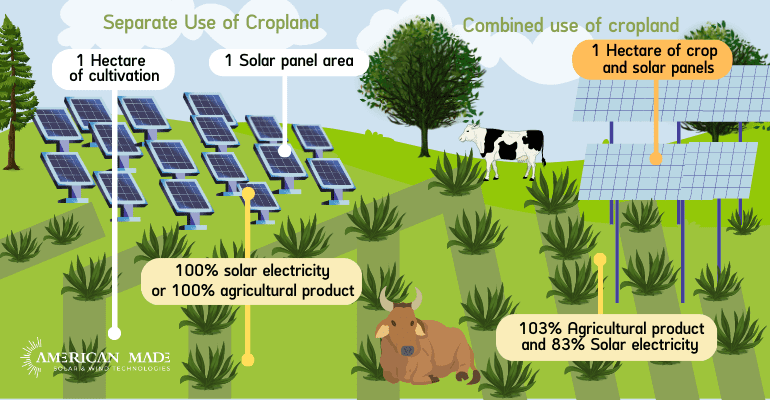
Agrovoltaics energy consists of using the same area of land to acquire both solar energy and agricultural products. For example: solar panels coexist with crops on the same surface, or even with livestock.
How does it work? There are several ways, usually the most popular is to use fixed support systems to raise the solar panels several meters above the crop or pasture land. In this way, machinery such as animals can easily access the crops or pastures below.
Also, solar panels can be installed on the roof of a greenhouse or placed on elevated cables (“dynamic agrovoltaics”), allowing the panels to be moved if necessary over different plots of land.
Among the main environmental benefits of agrovoltaics energy is the reduction of greenhouse gas emissions in the agricultural sector.
In addition, the use and dual use of land for agriculture and energy alleviates pressure on ecosystems and biodiversity, which are the first to be affected when cultivation areas are expanded.
According to studies published by the specialized publication Nature two years ago, “If only 1% of arable land were also dedicated to solar electricity production, it would be possible to offset the world’s energy demand.
Agrovoltaics solves at least two critical needs. Solar power provides the renewable energy needed to mitigate the impacts of climate change while meeting global energy demand. Crops grown in conjunction with solar power help feed the world’s growing population, which is expected to grow by nearly 10 billion people by 2050, according to the United Nations.
Researchers at Cornell University have found that soybeans planted under 3.9-meter-high solar modules can positively affect solar panel temperatures and farm microclimates.
Cornell researchers have examined agrovoltaics to see if there is merit to the perception that co-located sites will see large trade-offs between food and energy production. The study showed how solar and crop production can not only coexist, but also how co-location improves the microclimate and surface temperature of solar PV modules.
They also developed a computational fluid dynamics (CFD) microclimate model, which they evaluated with experimental data to investigate the effects of panel height, light reflection (albedo) and the amount of water that evaporates (evapotranspiration) at a solar PV site. The results were published in Reported in Applied Energy.
“We now have, for the first time, a physics-based tool to estimate the costs and benefits of co-location of solar panels and commercial agriculture from the perspective of increased energy conversion efficiency and solar panel longevity,” mentioned lead author Henry Williams. a Ph.D. student in the Cornell University engineering department.
An agrovoltaics installation was demonstrated with soybeans growing under solar modules mounted 3.9 meters (13 feet) above the ground. The project resulted in solar module temperature reductions of up to 50 F(1OC) compared to solar farms mounted only 1.6 feet above bare soil.
The large number of solar panels needed to achieve relevant energy production in turn requires a large area of land, a fact that can end up affecting both the landscape and other uses of the land on which they are installed.
Moreover, the efficiency of these systems is never 100%. In an investigation. Nature recalls that “the efficiency of the solar panel varies depending on the microclimate of the place in which it is immersed”, is influenced by factors such as insolation, air temperature, wind speed and relative humidity.
Take advantage of federal government incentives for those who switch to solar energy.
Get a quote from us, and stop paying thousands of dollars on your electricity bills!


Leave a Reply