

Solar assets below estimates, report says.
Climate insurer kWh Analytics says in its 2022 solar generation index that solar assets are performing below expectations. The report incorporates data from industry contributors and kWh Analytics’ proprietary Heliostat database.
Solar Assets Report
On average, projects built after 2015 produced 7% and 13% less electricity than P50 production estimates. P50 means that there is a 50% chance in a given year that production will be at least a specified amount.
The report concluded that as the gap between actual and expected generation grows, the risk of underperformance jeopardizes investor returns and the industry’s ability to achieve sustainable growth.
Jason Kaminksy, CEO of kWh Analytics said “Underperformance affects investors and lenders who are important to the success and growth of solar projects.” “As an industry, we must work together to find ways to correct course to ensure the long-term financial health of the industry.
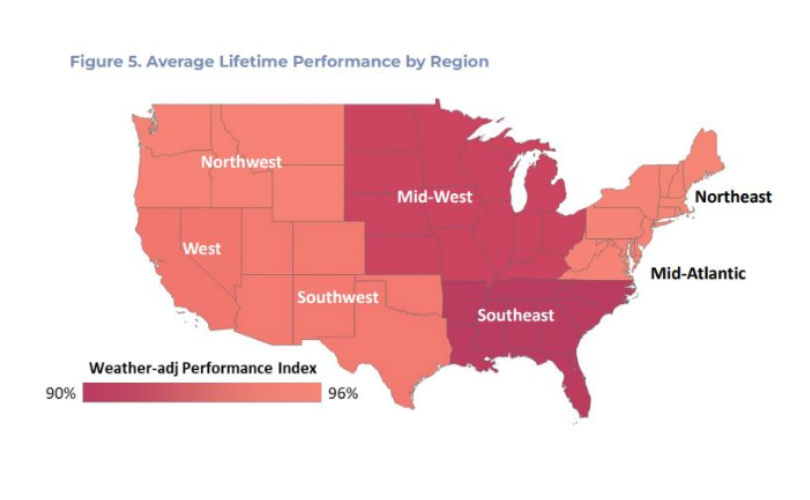
The trend of underperforming solar assets is national, commented kWh Analytics. With less than 10 years of operational data, lifetime average performance ranged from 5% to 10% below initial P50 estimates in all seven regions. Over the years, performance continued to decline in each region. In 2021 it was the Northeast and Southeast regions that improved by 1% and 2% respectively.
“It is imperative that we continue to support the long-term success of the renewables sector,’ said Kaminksy. “To de-risk investments in zero-carbon assets and foster resilience across the industry, sponsors and lenders should consider accurately priced risk transfer products, be wary of aggressive production forecasts, and collaborate with stakeholders to encourage data sharing.”
How to increase energy yield with optimization
PV systems suffer from energy losses due to mismatches. When modules do not perform identically, strong and weak modules have different power curves. In a non-optimized solar system, the inverter must make compromises to find the best operating point for the string of modules. If the string current is shifted down to accommodate the weak modules, the higher performing modules do not provide as much power as they could. If the bypass diodes in the weaker modules are activated, those cells do not contribute at all.
You can quote on American Made Solar & Wind Technologies, the best performing solar assets in the entire United States.


Leave a Reply